Packaging
Printed Labels
Self-adhesive, die-cut, on a roll.
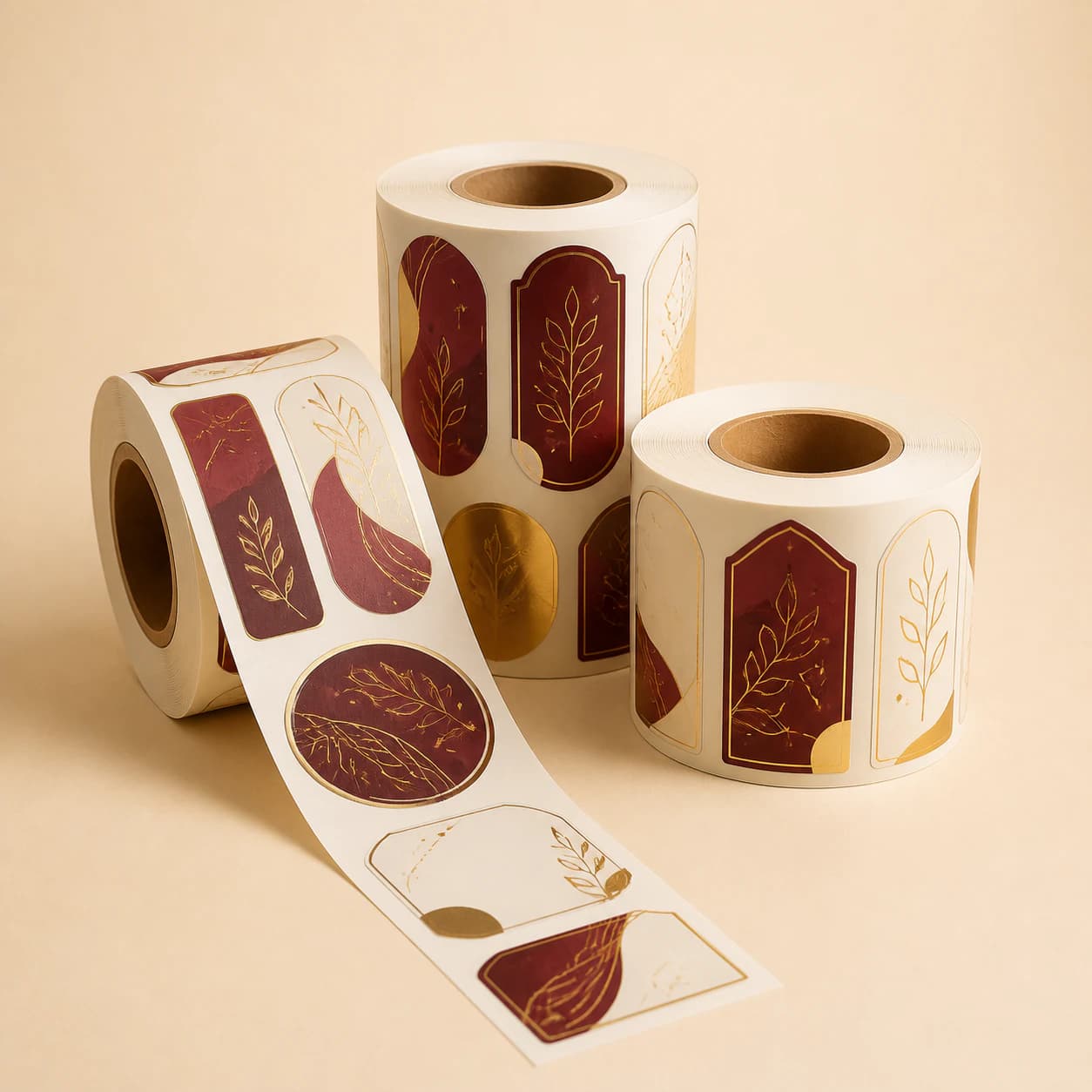
Self-adhesive labels, die-cut to shape and wound on a core. The cheapest way to brand a jar, a tin or an unprinted pouch — and the reason a small producer can hold one stock of plain pouches and label them per product instead of printing a separate film run for every SKU.
That last point is the strategy. Printed film has a cylinder cost and a four-figure minimum per design. Labels do not. If you sell eight products in the same pouch size, buying plain ready-stock pouches and eight label designs costs a fraction of eight printed film runs, and you can add a ninth product next month without a new cylinder. Almost every small brand should start here and move to printed film only for the SKUs that earn it.
The build. Paper or BOPP face stock with a permanent adhesive, 60 micron, matte, printed up to six colours. Paper suits dry goods and takes a warmer, more artisanal look. BOPP is plastic, survives moisture and handling, and is what you want on anything refrigerated, oily or likely to get wet.
Sizes. Standard die shapes at 50 × 75 mm, 75 × 100 mm and 100 × 150 mm. Custom shapes need a die, which is a one-off cost carried on the first order and free on repeats.
Applying them. Wound on a roll for machine application, or supplied for hand application. Tell us which, because it changes the wind direction and the gap between labels. Hand application on a curved surface is slower and less consistent than people expect — if you are labelling more than a few hundred units a week, a hand applicator pays for itself quickly.
Permanent adhesive. These are not removable. On glass and rigid plastic that is what you want. If the label has to come off cleanly, say so at enquiry — that is a different adhesive and it has to be specified before printing.
Ordering. Minimum 1,000 pieces, lead time 8 working days — the shortest in our printed range. Suits jars, pouches, bottles, tins and cartons.